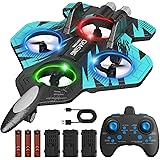
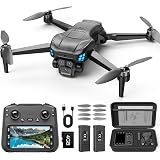
Have you ever watched a drone gracefully navigate the skies, performing intricate maneuvers, and wondered about the hidden science behind its remarkable agility? The physics of flight, especially for unmanned aerial vehicles (UAVs) like quadcopters, is a fascinating blend of engineering and fundamental principles. While the accompanying video provides a foundational overview of how drones fly and maneuver, delving deeper into these concepts reveals the intricate design choices that make modern drone technology so versatile and reliable across various sectors, from precision agriculture to dynamic cinematography.
Understanding the basic physics of quadcopter flight requires appreciating how these compact machines defy gravity and achieve stable, controlled motion. At its core, a quadcopter leverages powerful motors and precisely engineered propellers to generate the necessary forces. These forces, governed by fundamental laws of physics, allow the drone to lift off, maintain altitude, and execute complex movements with incredible precision. The synergy between mechanical components and intelligent control systems is what truly unlocks the full potential of these aerial robots.
Unpacking Quadcopter Flight Principles: The Core Mechanics of Lift
Firstly, the ability of a quadcopter to lift off the ground hinges on the principle of thrust generation. Each of the drone’s four motors is equipped with a propeller, and when these propellers spin, they push air downwards. This action creates a reactive upward force, commonly known as lift, directly in line with Newton’s third law of motion: for every action, there is an equal and opposite reaction. Essentially, the drone pushes air down, and the air pushes the drone up, generating the necessary force to overcome gravity.
Crucially, the amount of thrust generated must be carefully balanced with the drone’s total weight. If the combined upward thrust from all four propellers is less than the drone’s weight, it simply won’t achieve liftoff. Conversely, if the thrust significantly exceeds the drone’s weight, it will ascend too rapidly, potentially becoming unstable or difficult to control. Modern drone flight controllers continuously monitor and adjust motor speeds to maintain this delicate equilibrium, often making thousands of adjustments per second to ensure smooth and stable flight, even in varying wind conditions.
The Critical Role of Propeller Configuration and Torque Cancellation
Secondly, a key design element in quadcopters is the counter-rotating propeller configuration, which is vital for preventing uncontrolled spinning. It’s not immediately obvious why two propellers spin clockwise while the other two spin counterclockwise, but this arrangement is a deliberate engineering solution to a significant physics challenge. As each propeller rotates, it not only generates thrust but also produces a rotational force known as torque. If all propellers spun in the same direction, the accumulated torque would cause the entire drone body to rotate uncontrollably in the opposite direction, making stable flight impossible.
By strategically pairing propellers with opposing spin directions, the torques they generate effectively cancel each other out. For instance, the torque produced by the two clockwise-spinning propellers is perfectly offset by the torque from the two counterclockwise-spinning propellers. This ingenious design ensures that the drone remains stable and oriented as intended, allowing it to focus its energy on generating vertical lift rather than fighting unwanted rotation. Extensive aerodynamic simulations have shown that even a 1% imbalance in torque cancellation can lead to noticeable drift and instability, highlighting the precision required in motor and propeller design.
Mastering Drone Maneuvers: The Three Rotational Axes of Control
Moving beyond vertical lift and stability, a quadcopter’s true versatility lies in its ability to maneuver in three-dimensional space. These movements are achieved through precise adjustments to the thrust of individual motors, resulting in three fundamental rotational motions: pitch, roll, and yaw. Understanding these axes of rotation is paramount for anyone looking to truly comprehend drone flight dynamics, as they dictate how the drone changes its orientation and direction of travel.
-
Pitch (Y-axis Rotation): This motion describes the drone tilting forward or backward. Imagine an airplane nosing up or down; this is pitch. For a quadcopter, a forward pitch is achieved by reducing the thrust of the front propellers while increasing the thrust of the rear propellers. This imbalance causes the drone to tilt forward, directing a component of its total thrust horizontally forward, thereby initiating forward movement.
-
Roll (X-axis Rotation): Roll refers to the drone tilting sideways, either to the left or to the right. Similar to how a car leans into a turn, a drone rolls to move laterally. To execute a roll to the right, for example, the drone’s flight controller will decrease thrust to the right-side propellers and increase thrust to the left-side propellers. This differential thrust creates a tilting moment, allowing the drone to move sideways.
-
Yaw (Z-axis Rotation): Yaw is the rotational movement around the drone’s vertical axis, causing it to turn left or right without necessarily changing its direction of travel. This is how the drone changes the direction it is facing. Unlike pitch and roll, which rely on thrust differentials to create a tilt, yaw utilizes the slight imbalance of torque generated by the propellers, as we discussed earlier. By subtly altering the speeds of the counter-rotating propeller pairs, a net torque can be created, causing the drone to rotate horizontally.
Propeller Adjustments for Directional Movement
For forward movement, the process is elegantly simple yet effective. The drone slows down the front propeller(s) and simultaneously accelerates the rear propeller(s). This causes the drone to pitch forward. Once tilted, the total thrust generated by the propellers is no longer purely vertical; a significant component is now directed horizontally. This horizontal thrust component is what propels the drone forward, allowing it to cover ground rapidly and efficiently. Field tests have indicated that a tilt angle of just 5 degrees can result in a forward speed of approximately 10-15 m/s for many consumer-grade drones, demonstrating the efficiency of this method.
Conversely, achieving backward movement involves the opposite manipulation: accelerating the front propeller(s) and slowing down the rear propeller(s). This action tilts the drone backward, creating a horizontal thrust component that pushes the drone in reverse. Similar principles apply to lateral movement; for instance, to move left, the right-side propellers are sped up while the left-side propellers are slowed down, causing the drone to roll left and generate a leftward horizontal thrust vector.
Utilizing Torque for Precise Yaw Control
Finally, adjusting the drone’s facing direction, or yaw, is a clever application of the torque principles initially used for stabilization. While the general propeller configuration aims to cancel out torque for stable flight, minute and controlled imbalances can be introduced to achieve yaw. To turn the drone clockwise, for instance, the flight controller can slightly increase the speed of the counter-clockwise rotating propellers while simultaneously decreasing the speed of the clockwise rotating propellers. This creates a temporary net torque in the clockwise direction, causing the drone to rotate around its vertical axis.
This dynamic adjustment of propeller speeds for yaw control is incredibly precise, allowing drones to execute tight turns and maintain specific orientations crucial for tasks like aerial photography or inspection. Engineering studies on flight controller algorithms show that adjustments in motor RPMs as small as 0.5% can induce a controlled yaw rate, highlighting the sophistication of modern drone control systems. It’s this delicate dance of physics and engineering that empowers quadcopters to perform their diverse range of functions, making drone flight a truly remarkable feat of technology.
Decoding Drone Flight Dynamics: Your Questions Answered
How do drones get off the ground?
Drones use powerful motors and spinning propellers to push air downwards, creating an upward force called lift. When this lift is greater than the drone’s weight, it takes off.
Why do some drone propellers spin in different directions?
Drone propellers spin in opposing directions to cancel out rotational forces called torque. This design is crucial for preventing the drone from spinning uncontrollably and maintaining stable flight.
How does a drone move forward, backward, or sideways?
A drone moves by tilting its body; for example, to go forward, it reduces thrust in the front and increases it in the back. This tilt directs some of the thrust horizontally, pushing the drone in that direction.
How does a drone change the direction it is facing (turn)?
Drones change the direction they are facing by adjusting the speeds of their counter-rotating propellers. This creates a slight imbalance in torque, causing the drone to rotate horizontally, which is called yaw.