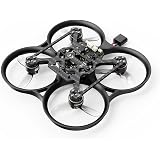
The world of FPV drones is constantly evolving, bringing exciting innovations and pushing the boundaries of what these compact flying machines can do. For enthusiasts of micro long-range drones, a new contender has emerged: the hexacopter version of the popular Flywoo Explorer LR4. This particular model, dubbed the Flywoo Hexplorer LR, clocks in at a dry weight of 210 grams, a notable increase from its quadcopter sibling’s 165 grams. This 45-gram difference, while seemingly small, significantly impacts flight characteristics and payload capacity, sparking a vital question for many pilots: Does the addition of two extra motors genuinely enhance its performance, or is it merely a novel experiment?
As detailed in the accompanying video by Joshua Bardwell, the Hexplorer LR marks a significant shift in the micro long-range category, offering not just more motors but a suite of impressive upgrades. Understanding these enhancements is crucial for anyone considering this unique 4-inch hexacopter for their next build or adventure.
The Evolution of Micro Long-Range Frames: Quad vs. Hex
The original Flywoo Explorer LR4 quadcopter frame has a revered lineage, tracing its roots to Dave C, a pioneer in the micro long-range domain. Its proven design set a high bar for durability and flight characteristics. To transform this robust platform into a hexacopter, Flywoo meticulously modified the bottom plate. The original top plate remains largely the same, but the bottom plate has been extended and redesigned to accommodate the additional arms. Each Y-shaped arm is secured by a single screw at the base and extends to meet with other arms, reinforcing the overall structure. This thoughtful design ensures that the extra motors are integrated without compromising the frame’s integrity, a critical consideration for any FPV pilot pushing the limits of their drone.
However, the most immediate and impactful difference is the weight. The standard quadcopter weighs 165 grams, but the Flywoo Hexplorer LR tips the scales at 210 grams. This 45-gram increase is substantial, especially for pilots aiming to stay under the crucial 250-gram limit for drone registration in many regions. Achieving decent flight times with a battery that keeps the hexacopter under this limit becomes a challenging balancing act. While the hexacopter boasts 50% more motors, theoretically offering 50% more thrust, its increased weight demands more power, directly affecting battery life and overall efficiency. This trade-off between thrust and weight is a fundamental consideration for any drone builder, especially in the long-range category where every gram counts.
Advanced Electronics: Beyond Just More Motors
Beyond the physical frame modifications, the Flywoo Hexplorer LR incorporates several significant electronic upgrades that truly set it apart from its quadcopter predecessor. These improvements are not merely incremental; they address common pain points experienced by FPV pilots and signal a commitment to pushing performance boundaries.
Upgraded Flight Controller: F7 Power and Enhanced Connectivity
A core improvement in the Hexplorer LR is its flight controller. The quadcopter version used an F4 processor, which, while capable, often led to issues like the DJI on-screen display (OSD) freezing due to limited hardware UARTs. UARTs (Universal Asynchronous Receiver-Transmitter) are essential for communication between the flight controller and various peripherals like GPS, receivers, and OSDs. With fewer UARTs, some functions had to share ‘soft serial’ ports, leading to instability.
The hexacopter, however, boasts an F7 processor. This isn’t just about raw speed; it’s primarily about the abundance of hardware UARTs – the video identifies an impressive seven on this 20-millimeter flight controller. This means critical components such as the GPS, DJI OSD, and receiver can each have their dedicated hardware UART, eliminating the frustrating OSD dropouts and freezes. This seemingly small upgrade dramatically improves the reliability and user experience, allowing pilots to always have clear, real-time flight data at their fingertips.
Integrated Barometer for Precise Altitude
Another crucial addition to the flight controller is an onboard barometer, or pressure sensor. GPS, while excellent for horizontal positioning, is notoriously inaccurate for determining altitude, particularly at higher elevations. A barometer, by measuring atmospheric pressure, provides highly accurate altitude data. This is especially vital for features like GPS rescue, where the drone needs to return to a safe landing spot at a controlled altitude. Without a barometer, GPS rescue could lead to erratic altitude changes, wasting precious battery energy or even climbing to an unsafe height. The inclusion of a barometer on the Flywoo Hexplorer LR ensures more reliable and safer automated return-to-home functions. Furthermore, this sensor also indicates compatibility with iNav, a popular open-source flight control firmware known for its navigation capabilities, making the hexacopter even more versatile for those interested in autonomous flight or advanced GPS missions.
Addressing GPS Performance Challenges
GPS signal acquisition and retention have long been a struggle for micro 4-inch drones. Pilots frequently experience long wait times for a GPS lock, insufficient satellites for reliable positioning, or even complete signal loss mid-flight. Some theories suggest interference from other onboard electronics, like the Caddx Vista, as a culprit. Flywoo has attempted to mitigate this by wrapping the GPS wires in copper foil to limit electrical interference. While this is a step in the right direction, and most effective when grounded, real-world experience, as discussed in the video, shows its effectiveness can be minimal. Improving GPS performance remains a key area for innovation in these compact long-range platforms, and many pilots actively seek tips and modifications to enhance this critical function.
The Convenience of Onboard Bluetooth
For pilots who prefer not to carry a laptop to the field, or simply desire a more streamlined setup experience, the integrated Bluetooth adapter on the Flywoo Hexplorer LR is a game-changer. This feature allows for wireless configuration of the flight controller using a smartphone app like Speedybee. Through the app, pilots can access and adjust nearly every parameter of their drone’s setup, from PID tuning to OSD layout. While complex command-line interface (CLI) commands might be cumbersome on a touchscreen, the ability to make quick adjustments and monitor telemetry without a physical cable connection is a massive convenience for field-side tuning and troubleshooting. This enhances the user-friendliness of the drone, making adjustments more accessible to a broader range of pilots.
A World First: The 6-in-1 ESC
The star of the show for any hexacopter is undoubtedly its Electronic Speed Controller (ESC). The Flywoo Hexplorer LR features the first-ever 6-in-1 ESC designed for a hexacopter in a 20-millimeter form factor. Traditionally, hexacopters require either multiple smaller ESCs or larger, often custom-made, solutions. This integrated 6-in-1 ESC simplifies the build process, reduces wiring complexity, and saves valuable space and weight within the compact frame. It’s a testament to engineering innovation, providing a clean and efficient power distribution system for the six motors, making hexacopter builds more accessible than ever before.
Optimizing Betaflight Settings for the Hexacopter
Even with advanced hardware, proper software configuration is paramount for optimal flight performance. Flywoo ships the Hexplorer LR with a solid default Betaflight setup, but experienced pilots often tweak settings for their specific flying style and battery choices. Understanding these adjustments can unlock the full potential of this 4-inch hexacopter.
-
Battery Voltage Thresholds: For pilots using high-voltage (LiHV) batteries, raising the maximum cell voltage in Betaflight from the default 4.3V to 4.4V is recommended. Conversely, if using lithium-ion (Li-Ion) batteries, which can be safely discharged to 2.5V without damage, adjusting the warning cell voltage from 3.5V down to 3.1V or even 3.0V can maximize usable flight time while protecting battery health. Standard LiPo users can typically stick with the defaults.
-
RSSI Setup: The Hexplorer LR comes pre-configured with AUX 8 as the RSSI (Received Signal Strength Indicator) channel. This is ideal for Crossfire users, who can output RSSI or Link Quality (LQ) on one of their auxiliary channels. For Crossfire, switching from the default 8-channel mode to 12-channel mode temporarily allows setting LQ to AUX 8, then reverting to 8-channel mode. This “best of both worlds” approach provides crucial signal strength feedback without performance penalties.
-
Stick Low Threshold: Betaflight’s default stick low threshold is 1050, a safety measure for uncalibrated controllers. However, once controller endpoints are correctly calibrated (channels spanning 1000 to 2000), lowering this threshold to 1010 reduces throttle deadband at the bottom, offering more precise low-throttle control. This subtle change can make a significant difference in smooth takeoffs and delicate maneuvers.
-
Custom OSD: While DJI provides basic OSD information, many pilots prefer a custom layout, especially for long-range flights. Integrating GPS-specific data, such as altitude and speed, alongside essential information like cell voltage and RSSI, enhances situational awareness. The flexibility to customize the OSD ensures pilots see exactly what they need, when they need it, improving both safety and flight experience.
-
GPS Rescue Failsafe: The Flywoo Hexplorer LR defaults to GPS rescue as its failsafe behavior, meaning it will attempt to fly home if signal is lost. Importantly, Flywoo enables “allow arming without fix,” giving pilots the option to arm and fly even if the minimum five satellites for GPS lock haven’t been acquired. This flexibility is excellent for quick freestyle sessions when GPS isn’t needed. However, for long-range flights where GPS rescue is critical, pilots must manually ensure a satellite fix before takeoff. It places responsibility on the pilot, balancing convenience with safety for different flight scenarios.
Flight Performance: Freestyle vs. Cruising and Payload Capacity
The true test of any drone lies in its flight performance. The addition of two motors suggests enhanced thrust and payload capacity, but how does this translate into real-world flying, especially when compared to its quadcopter counterpart?
Freestyle Capabilities: A Heavy Contender
Flywoo’s marketing suggests the Hexplorer LR has enough thrust for freestyle maneuvers and carrying a full-size GoPro. With an 850 mAh 4S battery and a GoPro Hero 8 attached, the all-up weight can easily exceed 550 grams. This is a considerable mass for a 4-inch platform. Flight tests reveal that while it *can* freestyle, it’s a “chonker.” Lift-off requires about 45-50% throttle, significantly higher than lighter drones. Full throttle punches show noticeable battery sag, and recovery from dives can feel heavy. The default tune, as observed in the video, exhibits a distinct bounce, indicating it’s not optimally tuned for aggressive freestyle flying. Compared to dedicated 5-inch freestyle drones or even optimized 4-inch quads without a GoPro, the Hexplorer LR feels less snappy and responsive for high-energy acrobatics. While Hypersmooth on the GoPro can mask some of the micro-oscillations, the underlying weight and tune limitations for freestyle are evident.
Cruising and Payload: Where the Hexacopter Shines
Despite its limitations in aggressive freestyle, the Flywoo Hexplorer LR truly finds its niche in cruisy, long-range flying, especially when carrying a full-sized GoPro. Many pilots prefer the durability and image quality of a full GoPro Hero 8 over a “naked” GoPro, which requires extensive modification and sacrifices ruggedness. For steady, cinematic cruising, the hexacopter’s increased thrust allows it to carry the heavier payload with greater stability and less effort than a quadcopter of similar size. While hard freestyle might deplete an 850mAh 4S pack in approximately 3 minutes 30 seconds, a cruisy flight could extend this to 6-8 minutes, or even 10 minutes, all while capturing high-quality, stabilized footage from a full-sized action camera. This enhanced weight-carrying capacity for stable, relaxed flights is a strong argument for the hexacopter’s design, providing a practical solution for pilots who prioritize cinematic shots and durability without venturing into larger, heavier drone classes.
The extra two motors undeniably provide more thrust headroom, allowing the 4-inch hexacopter to handle payloads that would strain or overwhelm its quadcopter brethren. This makes the Flywoo Hexplorer LR an excellent choice for those focused on carrying a GoPro Hero 8 or similar full-sized camera for smooth, extended aerial videography, where the slight trade-off in agility for raw lifting power and stability is a worthwhile compromise.
HEXPLORER LR: Your Q&A Debrief
What is a hexacopter like the Flywoo Hexplorer LR?
A hexacopter is a type of drone that has six motors and propellers, unlike a quadcopter which only has four. This design typically offers more thrust and stability for carrying payloads.
What are some of the key features of the Flywoo Hexplorer LR?
It boasts an F7 flight controller for better performance, an onboard barometer for accurate altitude, and built-in Bluetooth for easy wireless configuration. It also features a unique 6-in-1 ESC to manage its six motors efficiently.
What is Betaflight and why is it important for this drone?
Betaflight is the software that controls how the drone flies. It’s important because you can adjust settings within Betaflight to fine-tune the drone’s performance for your specific flying style and battery type.
What kind of flying is the Flywoo Hexplorer LR best for?
The Flywoo Hexplorer LR is best suited for smooth, cinematic long-range cruising, especially when carrying a full-sized action camera like a GoPro. Its design allows it to carry heavier payloads with greater stability compared to a quadcopter.